


What are the EU institutions? Seven principal bodies: the European Parliament, European Council, Council of the European Union, European Commission, Court of Justice, European Central Bank and Court of Auditors. Their jobs fall into legislative, executive, judicial and financial groups.
Readers following how these bodies touch residency and status questions can continue with eu citizens rights after brexit.
How this list is ordered
The bodies are not ranked, because none is “best” or “most important” in a way the evidence supports. The list instead follows the function a reader is most likely to be looking for, so each entry can be read alone. The University of Illinois law library guide describes the roles of the EU’s seven principal institutions in this way, and the same seven are covered here.
- Legislative: the European Parliament and the Council of the European Union, which handle the passing of EU laws.
- Executive and agenda-setting: the European Commission, which proposes laws, and the European Council, which sets political direction.
- Judicial: the Court of Justice of the European Union, which interprets EU law.
- Financial: the European Central Bank for monetary policy and the European Court of Auditors for oversight of the EU budget.
The first split to learn is between the two similar-sounding “councils”, which the section after the table untangles. The legislative bodies come first.
Legislative institutions
Two bodies sit on the lawmaking side: one elected directly by voters, one made up of national ministers. Neither can start the process alone, because the right to propose belongs to the Commission.
European Parliament
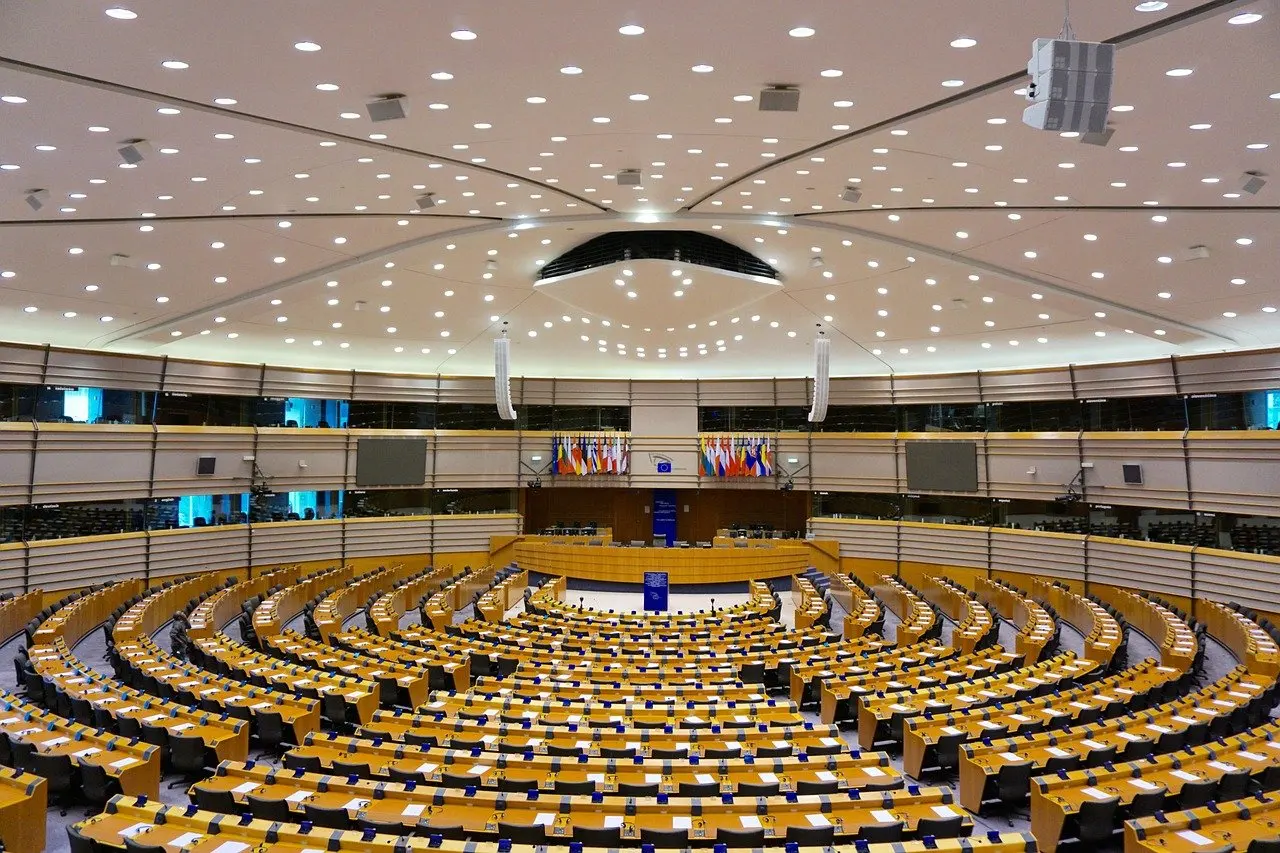
The European Parliament is the directly elected institution. According to the Illinois guide, its members are elected every five years on the basis of proportional representation. The UCLA law library guide adds an important limit: Parliament does not initiate legislation, but it may ask the European Commission to do so.
It suits readers who want to know where citizens’ votes feed into EU decisions. For the mechanics of voting, see how do European Parliament elections work. Its plenary chamber is in Strasbourg.
Council of the European Union
The Council of the European Union adopts EU legislation, as the Swedish Riksdag’s EU guide puts it. The Illinois guide describes it as functioning primarily as the upper chamber of the EU’s legislature.
Its membership is not fixed. Ministers from national governments attend, and which ministers turn up depends on the topic under consideration. Its presidency rotates every six months among the member states. This is the body to watch when the question is how national governments shape a specific law. Its meetings are in Brussels, in the Europa building.
Executive and agenda-setting institutions
These two bodies steer the Union rather than pass its laws. One drafts proposals, the other sets the political direction.
European Commission
The European Commission proposes new EU legislation. The UCLA guide states that it is the only body that may propose new legislation. It is composed of 27 members serving a five-year term, and the current term runs 2024–2029. Its headquarters, the Berlaymont building, is in Brussels.
This is the entry for anyone asking who writes the first draft of an EU law. Because it holds the sole right of proposal, requests from Parliament still pass through it.

European Council
The European Council consists of the 27 EU heads of state and government, according to the Riksdag guide. Its summits are held in Brussels, at least four times a year. The Illinois guide notes that, although it has no formal legislative powers, it sets the EU’s policy-making agenda.
The Riksdag guide is explicit that the European Council is not involved in the adoption of new EU legislation. It does, however, appoint the President of the European Central Bank and the members of its Executive Board. Choose this entry when the question is about political priorities or top appointments rather than about the text of a law.
The judicial institution
Court of Justice of the European Union
The Court of Justice of the European Union exists to ensure the uniform interpretation and application of EU law, according to the Illinois guide. The same guide says the Court of Justice constitutes the EU’s final court of appeal. It sits in Luxembourg.
The Court of Justice of the EU’s role is interpretive and corrective: it does not write laws. It matters most to readers who want to know why a national court and an EU rule can give different answers, since the Court is the body that settles what the EU rule means.
Financial institutions
Two bodies deal with money, and they could hardly differ more. One sets monetary policy, the other checks how the EU spends its budget.
European Central Bank
The European Central Bank is charged with setting and implementing monetary policy and is responsible for issuing the euro, as the UCLA guide explains. The Illinois guide gives its primary objective as maintaining price stability and keeping inflation low.

The ECB is a monetary authority, not a lawmaker, so it is the answer to questions about interest rates and the euro rather than about legislation. Its President and Executive Board are appointed by the European Council, which links this entry back to the political bodies above.

European Court of Auditors
Despite its name, the Court of Auditors is not a judicial body, the Illinois guide states. It carries out investigative oversight of the EU budget and issues an annual report to the European Parliament.
It suits readers who want to follow accountability for EU spending. Do not confuse it with the Court of Justice: the Auditors examine how money is used, while the Court of Justice interprets law.
Comparison of the seven institutions
| Institution | Function group | Key feature | Planning use |
|---|---|---|---|
| European Parliament | Legislative | Elected every five years by proportional representation; cannot initiate legislation | Look here for the democratic link and for requests that the Commission act |
| Council of the European Union | Legislative | National ministers, varying by topic; upper chamber of the legislature | Look here for how member-state governments shape a law |
| European Commission | Executive | 27 commissioners; only body that may propose new legislation | Look here for the origin of a draft law |
| European Council | Agenda-setting | No formal legislative powers; sets the policy agenda | Look here for political direction and top appointments |
| Court of Justice of the European Union | Judicial | Ensures uniform interpretation and application of EU law | Look here for what EU law means in dispute |
| European Central Bank | Financial | Sets monetary policy and issues the euro | Look here for price stability and the euro |
| European Court of Auditors | Financial | Not judicial; oversees the EU budget | Look here for audit findings on EU spending |
The table draws on the University of Illinois guide and the UCLA law library guide.
Which institutions make, enforce and interpret the rules
Lawmaking is shared: the Commission proposes, and the Council of the European Union adopts legislation, while Parliament is the elected body that may ask the Commission to act. The Court of Justice interprets and applies EU law, and the ECB acts in its own field of monetary policy. The European Council and the Court of Auditors do not legislate.
Council of the EU versus European Council
The two names are easy to mix up, and the distinction decides which body a news story is about. The Council of the European Union is a lawmaking body with changing ministerial membership and a presidency that rotates every six months. The European Council is a summit of 27 heads of state and government that sets direction without adopting new legislation.
The Commission and the European Council are another frequently confused pair, one drafting proposals and the other setting the agenda. The European Commission vs European Council difference is covered in its own guide.
Frequently asked questions
Which are the seven formal EU institutions?
They are the European Parliament, the European Council, the Council of the European Union, the European Commission, the Court of Justice of the European Union, the European Central Bank and the European Court of Auditors.
What does the European Central Bank do in one sentence?
It sets and implements monetary policy, issues the euro and aims to keep prices stable and inflation low.
Is the Court of Auditors a court that decides legal cases?
No. It is not a judicial body. It investigates how the EU budget is handled and reports each year to the European Parliament.
Can the European Parliament propose laws?
Not directly. Parliament does not initiate legislation, but it may ask the European Commission to do so.